We take AI systems to production. Models are nondeterministic components:
we wrap them in deterministic engineering (solvers, validators, release
gates, monitoring) and operate the result as a business.
aAn AI prototype that must become a reliable, paying
product.
bA document or render pipeline that needs deterministic
validation.
cAn inference workload that is too slow or too
expensive.
dRepetitive operations that should run unattended.
Full engagement notes at the end — one
address, same-day replies.
00
proof
html+css
11.5 KB gzipped
external requests
0
fonts
system only
analytics
none
built
2026-09-11
01
Vision & video intelligence
V-JEPA 2.1 · DINOv2-class
Dense self-supervised representations of video — V-JEPA 2.1 and
DINOv2-class patch features — turned into working tools that map,
search and segment video.
01.1
Dense-feature analysis
live · rendered on studio GPUs
Side-by-side loops — source video against its dense-feature
PCA-RGB projection, per patch, per frame. One PCA basis is fitted
per clip (top-3 components, robust-scaled), so a colour means the
same feature direction for the whole clip; the patch grid is
upsampled to pixel resolution with an RGB-guided filter and
stabilised with motion-adaptive temporal smoothing. Watch the
person, sky and ground separate without a single label.
source | PCA-RGB — V-JEPA 2.1 ViT-L/16, 80×45 patch grid; clip generated in-house (Wan2.2)source | PCA-RGB — V-JEPA 2.1 ViT-L/16, 80×45 patch grid; footage: David Osipov, “Tbilisoba 2024. Georgian dances near Liberty Square” (Wikimedia Commons), CC BY 4.0 — 6 s excerpt, mutedsource | PCA-RGB — DINOv2 ViT-g/14, 91×51 patch grid; clip generated in-house (Wan2.2)source | PCA-RGB — DINOv2 ViT-g/14, 91×51 patch grid; clip generated in-house (Wan2.2)
01.2
Embedding atlas
live demo
A video laid out as navigable semantic space: every patch of
every frame embedded with V-JEPA 2.1, UMAP-projected to 3D on
studio GPUs, one point per patch per frame — 59,840 points from
the rainy-plaza clip above, coloured by a PCA-RGB projection of the
same patch features. Orbit; hover
a point for its patch thumbnail, frame index and timestamp; the
dual-thumb scrubber filters by frame range. The map is not an
illustration — it is the working index, and the same space powers
the moment search below.
59,840 records (1.2 MB) + thumbnail atlas (0.2 MB) — 1.4 MB
total, fetched only as this section nears the viewport.
01.3
Moment similarity search
live · inside the atlas above
Click any point in the atlas above and the nearest moments across
all 59,840 patches light up — an exact cosine ranking computed in
your browser over 32-dimensional int8 embeddings, in about two
milliseconds, no server round-trip. The query chips run the same
highlight from seventeen text prompts whose matches were
precomputed offline and hand-checked; three prompts that did not
genuinely match the scene were discarded rather than shipped.
01.4
Promptable video segmentation
live · rendered on studio GPUs
Open-vocabulary instance segmentation on video: name a concept in
plain text — “person”, “skateboard” — and every instance is
detected, masked and identity-tracked across the clip, with no
fine-tuning. Each identity keeps a fixed colour, so you can watch
tracking hold through motion and occlusion: in the street-dance
clip, all 73 people in the crowd are tracked individually.
source | instance masks — SAM 3 promptable video segmentation, text concept “person”; all 73 people detected and identity-tracked, one fixed colour per identity. Footage: David Osipov (Wikimedia Commons), CC BY 4.0source | instance masks — SAM 3, text concepts “person” + “skateboard”; skater and board segmented as separate concepts. Clip generated in-house (Wan2.2)
02
Generative & inference engineering
kernels · quantisation · gates
Generative and vision models made fast enough — and verified enough
— to run as products on our own hardware.
02.1
Attention-kernel overlay
production
A custom attention-kernel overlay for an open 14B text-to-video
diffusion transformer, running on studio-owned GPUs. Measured on
the production workload against the unmodified pipeline:
text-to-video denoising, open 14B diffusion transformer
output
736 × 528 px · 81 frames
schedule
40 denoising steps
end-to-end denoising time
392.9 s → 333.3 s
end-to-end reduction
15.2%
mean step time
9.06 s → 8.15 s
LPIPS vs reference
0.0202
PSNR vs reference
34.9 dB
SSIM vs reference
0.966
attention backends verified
3
kernel fallbacks
0
The overlay replaces the attention kernels inside the denoising loop; the rest of the pipeline is untouched.
Query–key scoring runs on an int8 path.
Each of the three attention backends gets its own overlay; none falls back to a stock kernel.
Validation is authoritative; the model is not: a golden-frame comparator checks optimised output against the reference pipeline, frame by frame, under fixed LPIPS / PSNR / SSIM acceptance bands.
The quality gate — LPIPS 0.0202, PSNR 34.9 dB, SSIM 0.966 — held before the overlay was adopted.
03
Physical AI & simulation
deterministic multi-physics
research prototype · engine output 2026-08-19
A GPU-native, deterministic multi-physics engine for robotic
manipulation — custom solver, coupling, validity and determinism
architecture, implemented from scratch atop NVIDIA Warp. Rigid-body
contact and friction with the static↔kinetic transition,
articulated joints and grippers, free-surface liquids (SPH and
hybrid grid-particle), liquid-to-surface deposition → film flow →
wet-friction coupling, and cloth with self-collision — one GPU
pipeline, not a composition of separate simulators.
The coupling is causal: pour a liquid → it deposits on the
surface → the film flows → the contact becomes slippery. That
chain runs as actual mass transfer inside one CUDA stream,
against a closed mass ledger.
Determinism is bitwise. Every subsystem computes in fixed order —
no atomics, no hash grids — and full state hashes come back
bit-identical across 20 of 20 repeated runs, including with
enumeration order reversed. Every step also carries a validity
status — SUPPORTED / DEGRADED / INVALID / FAILED — so numerical
trouble never hides behind a clamp or a silent fallback: a
failure is recorded as a failure.
single NVIDIA RTX PRO 6000 Blackwell-class GPU · Python 3.12 +
NVIDIA Warp
03.1
Recorded rollouts
Offline renders of actual engine state — the motion is the
recorded simulation output, untouched; slow-motion playback
(and, where captioned, playback-only frame interpolation) is
applied for inspection. Silent H.264 loops.
Dam break — a liquid column (5,070 SPH particles,
high-viscosity fluid) collapses in an 8 cm tank, drives a
surge wave to the far wall and settles. ~6× slow motion;
colour = depth (brighter at the surface) + velocity.
64 × 64 XPBD cloth patch dropped over a table pillar —
240 frames, 4 s simulated, 0.5× speed. Deterministic
cloth–rigid contact with no atomics, BVH or CCD; contact
penetration 2.6e-8 m in the 32² canonical measurement.
Squeeze and lift — a compliant-contact two-finger gripper
squeezes a 0.5 kg box, lifts it 0.12 m and holds. ~4× slow
motion; pressure×area vs normal-force self-consistency
1.9e-6, grip success/failure predicted 5/5 across the scene
family.
03.2
Measured results
Every capability is measured against analytic references and
matched open-source engine baselines, under pre-frozen
evaluation specs and sealed hold-out scenes; thresholds are
never adjusted after seeing results.
Measured on the stated scenes, thresholds frozen
beforehand. RTF = simulated time / wall-clock time;
1.0 = real-time.
measurement
result
conditions
articulation — pendulum period error
0.039%
vs analytic; zero energy gain
many-body collision — throughput
RTF 4.45 / 4.29 / 3.89
16 / 32 / 64 bodies; 240/240 steps SUPPORTED
liquid — density error
P99 ≤ 0.13%
all five scenes, validity SUPPORTED
liquid — momentum-ledger residual
~7e-15
dimensionless; ledger closed against external impulses
wet chain — end-to-end mass residual
1.16e-10 kg
pour → deposit → film flow → wet contact, one scene; six-stage provenance, three negative controls passed
wet friction — effective static μ vs film thickness
0.428 → 0.320 → 0.212
dry → thin → thick film, monotonic; dry case bitwise-identical to the independent rigid path
cloth — self-collision
0 penetrations · min signed gap +3.7e-5 m
vertex–triangle + edge–edge; no atomics, BVH or CCD
compliant grip — success/failure prediction
5/5
squeeze-and-lift scenes; pressure×area vs normal force self-consistent to 1.9e-6
determinism — repeated runs
20/20 bitwise identical
all subsystems, full state hash, enumeration-order reversal included
04
Deterministic solvers
from shipped products
Pure, deterministic solvers from our shipped print products —
ported verbatim and running in your browser.
04.1
Placement solvers
live demo
First exhibit: the grid packer from a shipped personalised-crossword
product, ported to this page verbatim and
running in your browser. It is a deterministic, pure constraint
solver: it verifies shared-letter connectivity across the answer
set, pins the chosen anchor word, then places entries in
most-constrained-first order with backtracking, scoring each
complete layout and keeping the best.
Edit the word list — ten to fourteen answers — and it re-packs
live, reporting attempts, backtracks, elapsed milliseconds and the
layout score. Shuffle the anchor to force a different solve.
Second exhibit: the seeded word-search engine from the companion
print product. Placement is driven entirely by a seeded generator —
hash the seed, shuffle candidates, place with bounded backtracking,
fill with generator-drawn letters — so the same seed always yields
the same puzzle, byte for byte. Determinism here is not a debugging
aid; it is the product contract that makes every paid artifact
reproducible.
05
Autonomous operations
the fleet
production
A watcher fleet runs around the clock — six watchers on three-minute
to thirty-minute cadences covering marketplace scans, mail, order
flow, and bounty and listing deltas — feeding a persistent agent
loop that acts under human direction. Synthetic buyer journeys feed it evidence, and when something breaks, the fleet writes
the incident note itself.
fleet-written incident note from a live messaging-bridge failure;
identifiers sanitised.
L1
3D→text renderer
lab · Glyphit3D — WebGPU, live
lab — exploratory systems,
shipped when they beat the incumbent.
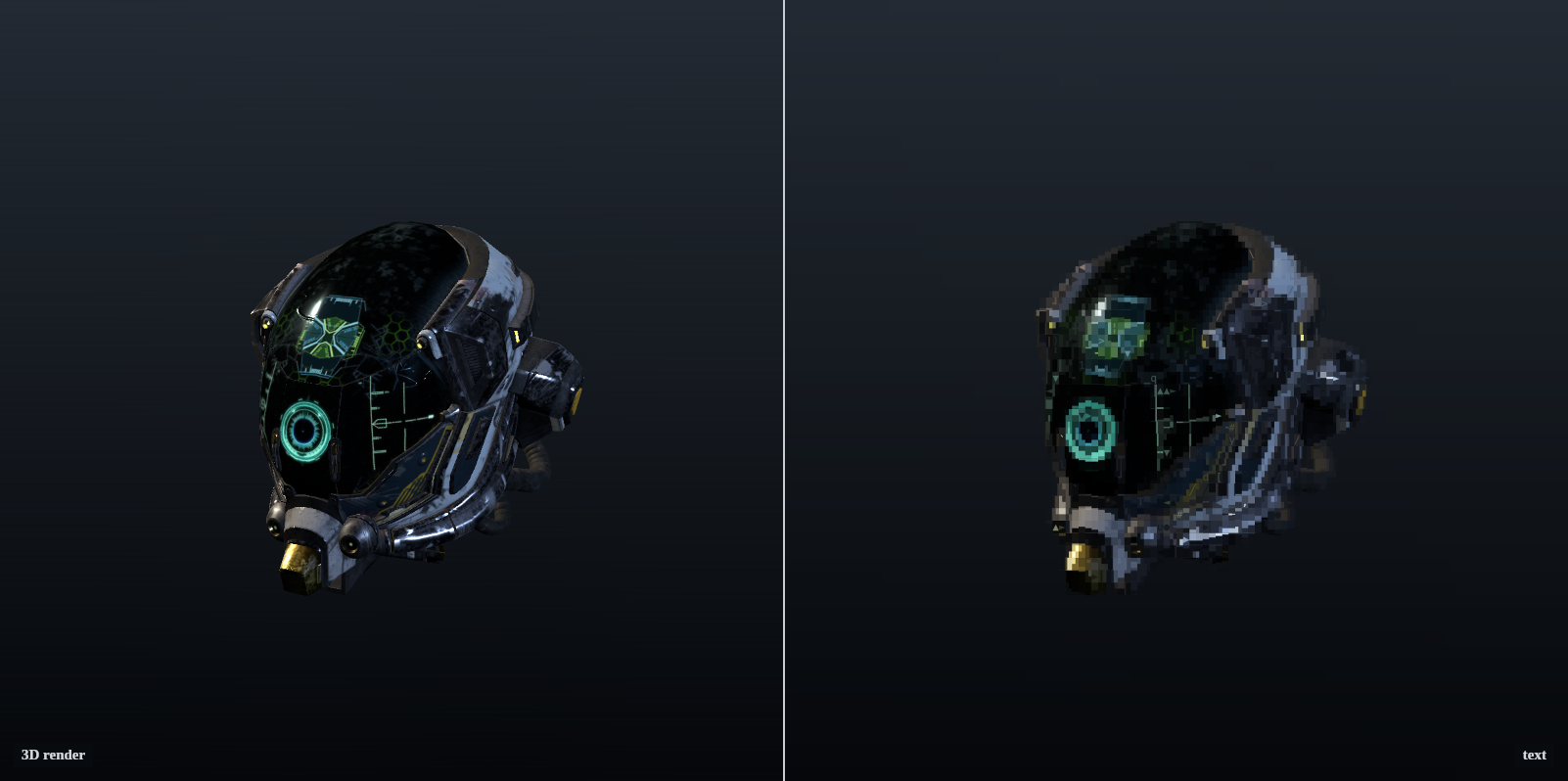
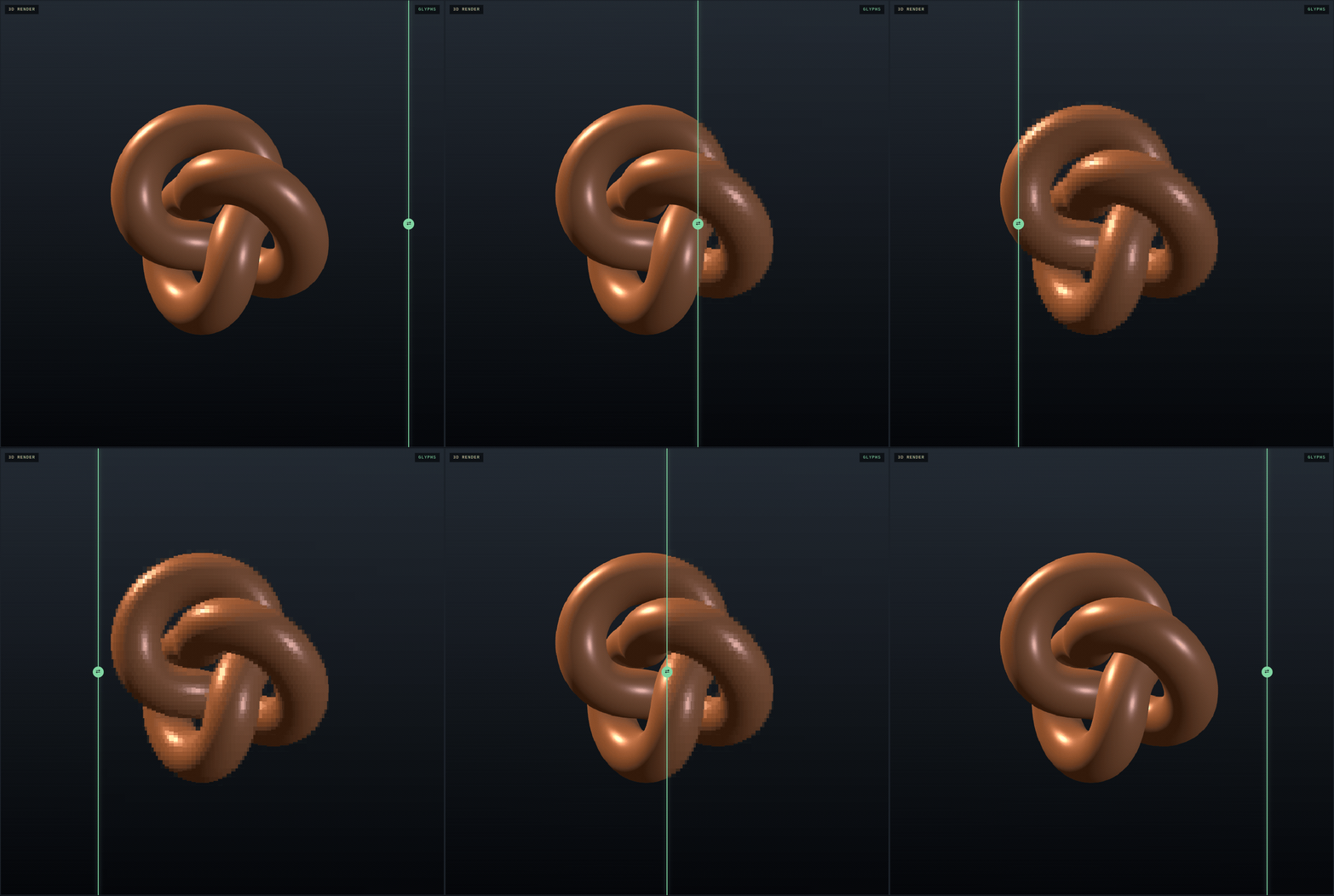
Glyphit3D renders live 3D scenes entirely as text: one glyph and two
colours per character cell, re-chosen every frame. Selection is
driven by the G-buffer rather than luminance alone, and each cell's
foreground and background colours solve a continuous-coverage
two-colour least-squares fit. It runs in WebGPU at quality Q3 inside
a ~50 ms frame budget; without WebGPU the same matcher runs on a CPU
worker pool.
Drag the divider to sweep between the native render and the glyph
raster, orbit the model, or drop your own .glb/.gltf into the frame.
We reply from a running system, usually same-day. One address, no
form — there is no backend here to spam. Send the system, the
bottleneck, or the failure mode.